

Rethinking the NBA's 65-Game Rule
A decade of data suggests there’s a better balance between availability and excellence

In the 2022-23 NBA season, Giannis Antetokounmpo was unquestionably a dominant force. He led the league in field goals made, two pointers, and defensive rebounds per game. He averaged 31.1 points per game on a Milwaukee team that finished first in the Eastern Conference. He finished third in MVP voting that year and was without a doubt one of the best players in the sport.
But in that season, Giannis only played 63 games. If he had that exact same season the following year, he would have been ineligible for MVP and All-NBA honors. The NBA, reacting to players missing games due to load management implemented the 65-game rule—where a player had to appear in at least 65 games to qualify for awards.
The rule has faced some scrutiny this season as elite players like Nikola Jokic, Shai Gilgeous-Alexander, and Victor Wembanyama are at risk of not qualifying for awards because they will have missed too many games due to injury. The NBA is in a tough spot with the rule, with many calling for its abolition while others have advocated that ensuring availability is part of being a star player. But perhaps the solution doesn’t need to be so absolute—maybe there is a middle ground to be reached for the NBA.
The Logic of the Rule

In the 2010s, the NBA had an issue concerning its regular season—players were being rested strategically. During that period, the San Antonio Spurs rested their star players throughout the regular season to maximize their health for the playoffs. The team’s decision to do this makes sense holistically. A team that wins the NBA Finals will play 16-28 extra games on top of the 82-game regular season. Thinking rationally, those extra games have a much heavier weight than the 82 regular season games, so it makes statistical sense to optimize for the playoffs.
In his career with the Chicago Bulls, Michael Jordan played a total of 1,109 games. 179 of those were playoff games—meaning that 16% of his career appearances were in the postseason. Those games were also his most important, which speaks to a balance that modern teams are looking to strike: to use the regular season as a launching pad for playoff success.
The side effect of the outweighed importance of the regular season is that players rest during the year in the name of strategy, rendering the regular season meaningless in the eyes of many observers. A tired trope of sports commentary has centered around people loving the NBA Playoffs and hating the regular season. That is a problem for the NBA.
The league recognized that it is a sport driven by superstars, and that people paid their hard-earned money to watch superstar players—not young rookies trying to capitalize on a development opportunity because of a load management game. That led to the 65-game rule. By requiring availability as a metric for awards, and thus more lucrative contracts, the NBA sent a message to its players and teams.
The spirit of rule made sense. Requiring players to appear in 80% of the team’s games to qualify for accolades seems reasonable. While aimed at curbing load management, the rule doesn’t have a provision for sustained injuries that caused players to miss time. Those players may still be impactful but because they did not hit an arbitrary threshold, they became ineligible.
Giannis Antetokounmpo’s 2022-23 season is proof of this. Giannis has never been the type of player during his career to load manage, and yes, he missed 19 games and would have been ineligible had the rule been enacted that season. That would have disqualified one of the best players in the league from recognition and been a poor representation of what constituted greatness in that season.
In the ten years before the rule was implemented, Giannis was not the only one that wouldn’t have met the threshold that is currently the standard. With that being a trend, it is fair to wonder if the rule, while made in good faith with sound logic, ended up being a little more punitive than intended.
A Decade of Data
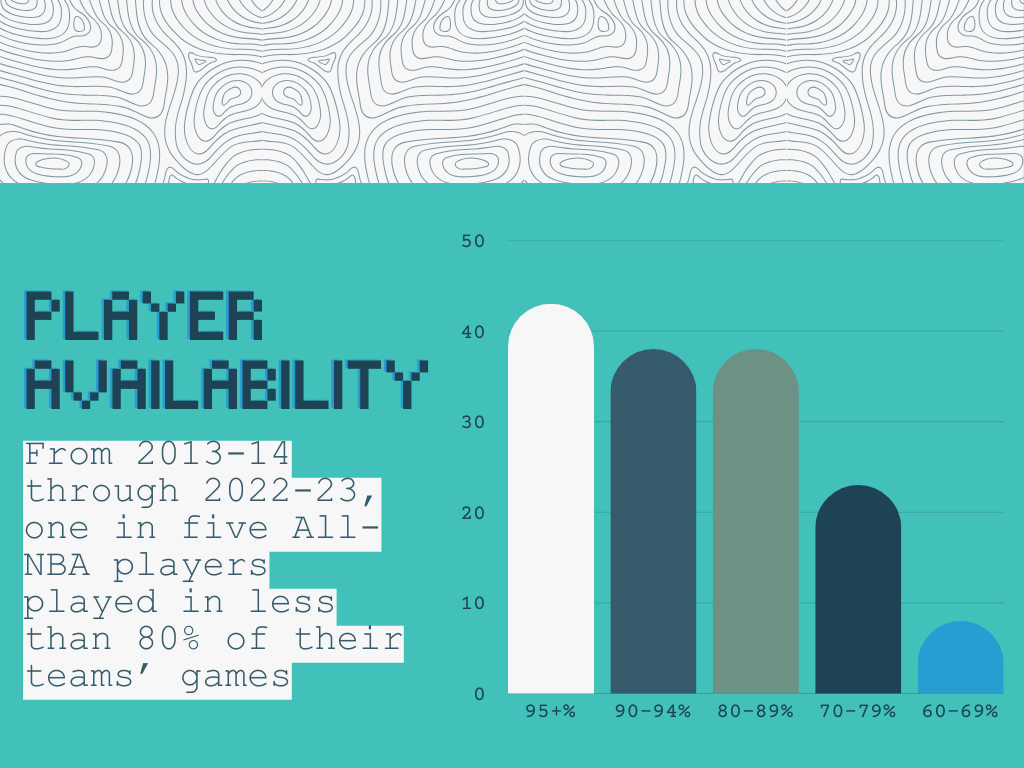
What the 65-game rule asks of superstar NBA players is to be available for 80% of their teams’ games. Looking at All-NBA selections from league and Basketball Reference data over the ten seasons prior to the rule’s implementation in the 2023-24 season, 20.67% of All-NBA players would not have qualified for the accolade if the rule was in place. But these players are still worthy of recognition.
Consider the case of Ja Morant in 2021-22. During that season, Morant was named an All-Star, won the Most Improved Player Award, and even received MVP votes. The Grizzlies were the second seed in the West as he averaged 27.4 points, 5.7 rebounds, 6.7 assists, and 1.2 steals per game. It was the best statistical year of his career, and he was the primary option on an elite regular season team.
But he only played 57 games that season thanks to two separate injuries that sidelined him for multiple games—a left knee sprain in November 2021 and a second knee injury in March 2022. Morant was not load managing, but in today’s landscape he would have been ineligible for awards.
In the 2024-25 season, three of the NBAs top ten scorers—Luka Doncic, Kevin Durant, and Tyrese Maxey—did not meet the threshold in games played. In previous seasons, at least one of them would have at least been considered for the honor. From 2013-24 through 2022-23, the bulk of All-NBA players played in most of their teams’ games, with 54% appearing in 90% or more of their games and 79.33% appearing in 80% or more of their games.
At the core of the 65-game rule as it is currently constituted, there is a core philosophy that deserves merit. Fans come to NBA arenas to see star players, especially in road games. A fan excited to see Kevin Durant when the Rockets visit their city only to have him rested for that game is discouraging for fans. The 65-game rule attempts to curb that, which is an admirable pursuit.
But the cases of valuable players dealing with legitimate injuries rather than strategic rest that might miss time because of load management presents issues with regards to who is recognized. This season Luka Doncic, Nikola Jokic, Victor Wembanyama, and Shai Gilgeous-Alexander have all been at risk of not qualifying for All-NBA or awards, which is not indicative of just how great these players are. A better solution than simply removing the rule is to make it less punitive.
The 55 Game Rule

In the ten years before the advent of the 65-game rule, every player that was named to an All-NBA team played in more than 61% of their teams’ games (which would equate to 50 games played in an 82-game season). A 55-game rule would require a player to play in at least two thirds of his team’s games, which still feels reasonable regarding keeping player availability a priority.
In fact, from 2012-13 through 2022-23, only two players would not qualify by this metric: Steph Curry in 2017-18 (51 out of 82 games) and LeBron James in 2020-21 (45 out of 72 games). By adding this slight buffer, teams and players would not feel the pressure to rush a player back from injury prematurely, as was the case for Tyrese Haliburton in the 2023-24 season.
The Pacers guard had a breakout season that year but because of the 65-game rule, he rushed back prematurely to ensure that he qualified for an All-NBA spot. For Haliburton, making All-NBA was essential because it could have led to an additional $41 million in his max contract extension.
It is plausible to suggest that rushing back from injury during the regular season, set Haliburton up poorly in the postseason. The same hamstring that he injured during the regular season was reaggravated in Game 2 of the Eastern Conference Finals against the Celtics. Haliburton would go on to miss the rest of that series as the Pacers were swept by Boston.
By providing an added buffer, a 55-game rule still ensures that players are active for most of the regular season, maintaining the importance of regular season participation that the league craves. By reducing the number of games, it also reduces the pressure on injured players to come back too soon and risks further injury.
Beyond that, this sort of relaxation of the rule also preserves the storytelling of an individual NBA season, which is a side effect of the rule that many may have overlooked.
Preserving Historical Memory

Basketball Reference is a site I use incredibly frequently to pull stats for players. When you select a player page, on the right-hand side it will reflect their accolades. It will mention awards, championships, Hall of Fame, All-Star selections, All-Defense, and All-NBA selections. All-NBA specifically, has long been a benchmark of who the best players in the league are.
Twenty years from now, someone might look at Nikola Jokic’s Basketball Reference page and be slightly puzzled if he ends up not meeting the 65-game requirement this year. They will see seven consecutive All-NBA selections and then see a year where he led the league in multiple categories and wasn’t named All-NBA. They would then look at the players that were selected and wonder what happened to cause this error.
That’s the risk of the 65-game rule as it currently stands. Jokic, who is considered an MVP frontrunner, being disqualified from being nominated for the award and selected for All-NBA would be a disservice to basketball history.
Jokic, Wembanyama, and Doncic are all perilously close to not qualifying for awards, and they are all players that will receive some MVP votes. At that point, the exercise becomes less about reducing load management and more about punishing players for being injured.
The NBA has valid concerns about the regular season not being treated with the respect it deserves by its players. But punishing a player for playing hard and being injured as a result should not be one of the ways to solve it. By reducing the threshold to 55 games, the league is still holding players accountable for participation while also allowing players to miss games due to injury. The question isn’t whether availability matters—it’s whether the league wants its history to reflect the reality on the court.